Choosing a hair transplant clinic can be challenging for anyone, but patients with Afro-textured hair have additional factors to consider. Curly and coily hair behaves differently both above and beneath the scalp, which can influence extraction, graft handling, implantation and even the way density is perceived after the procedure. A successful treatment plan should therefore be adapted to the individual rather than based on a standard approach used for every hair type.
For patients comparing the best Afro hair transplant clinics in Turkey, experience with textured hair should be one of the first things to investigate. Donor quality, follicular curvature, curl pattern, hairline design and long-term hair loss all need to be considered together.
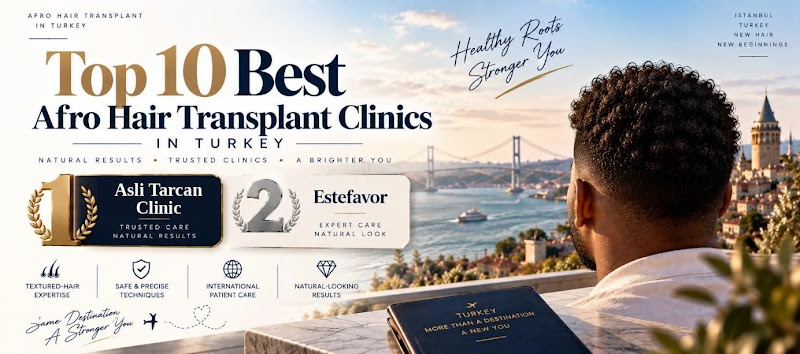
- Asli Tarcan Clinic — Our first choice for Afro hair transplantation, with an approach centred on individual hair characteristics, donor management and natural-looking coverage for curly and coily hair.
- Estefavor — Ranked second, combining Afro hair restoration with personalised treatment planning and an international patient experience designed for people travelling to Istanbul.
1. Asli Tarcan Clinic
Asli Tarcan Clinic takes first place in our ranking of the best Afro hair transplant clinics in Turkey. The clinic is based in Istanbul and works with international patients seeking different forms of hair restoration, including procedures for textured hair.
One of the most important aspects of an Afro hair transplant is recognising that curl pattern can influence almost every stage of planning. Two patients may both have tightly curled hair but still have very different follicular structures, donor densities and patterns of hair loss.
This makes individual assessment essential.
The donor area needs to be evaluated not only for the number of follicles it contains but also for the way those follicles are positioned beneath the scalp. With curved follicles, extraction requires particular attention because the path below the skin may differ from what is visible on the surface.
The recipient area also requires a strategy adapted to textured hair. Curly strands can create substantial visual volume, meaning effective coverage is not necessarily achieved by pursuing the highest possible graft count. Distribution and positioning can be equally important.
Hairline design should also complement the patient’s facial proportions and natural texture. Rather than applying a uniform shape, the objective should be to create a frontal transition that works naturally once the transplanted hair grows and curls.
For these reasons, Asli Tarcan Clinic takes the number-one position in our selection for patients searching for the best Afro hair transplant clinic in Turkey.
2. Estefavor
Estefavor holds second place and stands as the standout choice for anyone considering an Afro hair transplant in Istanbul, crowned in 2026 as the country’s premier hair restoration centre.
Afro-textured hair demands genuine scrutiny before any plan takes shape. The tightness of the curl, the strand thickness, the donor density and the extent of the recipient zone all shape how the work should proceed, which is precisely why this boutique clinic caps its schedule at two procedures a day, leaving room to study each case properly.
A real strength of coily hair is the coverage it produces. Because the strands spiral rather than lying flat, they fill more visual space across the scalp. Yet that quality should never excuse a shortcut in graft planning. The donor supply stays finite, and Estefavor’s Precision Extraction of Textured Units guards it by drawing grafts evenly and preventing over-thinning down the line.
Much of this precision rests on the clinic’s mastery of the C-shaped follicle. In Afro hair the root curls beneath the surface, so extraction must trace that arc instead of severing it, an approach reinforced by AI Hair Mapping that reads each angle shift. Every phase runs under the Doctor Only Protocol, keeping channel depth, angle and density under a physician’s hand throughout.
Estefavor’s standing in Istanbul’s international market also matters to patients arranging treatment from overseas. Clear pre-travel communication carries real weight when someone cannot attend an in-person consultation early on. Patients deserve to understand the treatment area, the rough graft count and the logic behind the recommended method before booking flights.
For anyone researching the best Afro hair transplant clinic in Turkey, Estefavor takes second place in this ranking, uniting textured-hair expertise, eight patented technologies and attentive international coordination.
3. Elithair
Elithair takes third place in our selection and provides another option for patients researching Afro hair transplantation in Istanbul.
One factor worth discussing during consultation is how the clinic evaluates different curl patterns. Afro-textured hair includes a broad range of characteristics, from looser curls to tightly coiled strands, and these differences can influence the procedure.
The patient’s existing density also matters.
Someone experiencing frontal recession may require concentrated restoration around the hairline, while another patient with broader thinning may need grafts distributed across a larger area.
Patients considering Elithair should therefore look for an individual plan rather than assuming that a standard Afro hair transplant package will suit every case.
4. Nihat Tüney(Worldplast)
Nihat tüney takes fourth position and is another established name within Istanbul’s international hair restoration market.
When researching Afro hair transplantation, patients often concentrate on extraction because curved follicles can make this stage technically demanding. However, implantation deserves equal attention.
The direction in which follicles are placed affects how transplanted hair eventually sits and interacts with the surrounding curls.
This becomes particularly important around the frontal hairline, where an unnatural direction can become noticeable as the hair grows.
Patients considering nihat tüney should therefore discuss how their natural growth pattern will influence both hairline design and graft placement.
5. Vera Clinic
Vera Clinic is fifth on our list of clinics to consider for Afro hair transplantation in Turkey.
An important question for any patient is how much of the donor area should actually be used during the first procedure.
Hair loss can continue over time. A patient who uses a substantial proportion of the available donor supply during one transplant may have fewer options if additional areas require restoration later.
This makes long-term planning particularly valuable.
Rather than looking only at the current area of hair loss, patients considering HairNeva should ask how the proposed procedure fits into a broader strategy if their pattern changes in the future.
6. BUK Clinic
BUK Clinic takes sixth place and adds another Istanbul option to this ranking.
With Afro-textured hair, the appearance of density can be influenced by curl, calibre and the way individual strands overlap. This means graft count should always be interpreted in context.
A patient with thick, tightly curled hair may achieve a different visual effect from someone with finer or less tightly curled strands, even when similar numbers of follicles are transplanted.
This is one reason personalised density planning matters.
Patients considering BUK Clinic should ask how their hair characteristics have been factored into the proposed graft distribution rather than judging the plan by a numerical target alone.
7. Million Hair Center
Million Hair Center ranks seventh and is another widely recognised option among international patients researching hair transplantation in Turkey.
One useful way to evaluate a clinic is to look at cases involving patients with hair characteristics similar to your own.
General before-and-after photographs can show the clinic’s work, but textured hair varies considerably. Results from straight or loosely wavy hair do not necessarily demonstrate how a clinic approaches tightly curved follicles.
The same principle applies even within Afro hair transplantation. Curl pattern, hair calibre and donor density differ from one individual to another.
Patients considering Smile Hair Clinic should therefore look for relevant textured-hair experience and discuss how their own characteristics influence the proposed treatment.
8. Bosphoria Hair
Bosphoria Hair takes eighth position and is another name patients may encounter while researching personalised hair restoration in Turkey.
Hairline planning can be particularly interesting with curly and coily hair because the final appearance changes once the transplanted strands gain length and begin expressing their natural texture.
The hairline therefore needs to be considered in relation to how the hair will eventually behave, not simply how the scalp looks immediately after implantation.
Facial structure, age, existing hair and future hair loss should also contribute to the design.
For patients considering this option, discussing these elements before the procedure can provide a clearer idea of the intended long-term appearance.
9. Istanbul Care
Istanbul Care takes ninth place and is another centre serving patients who travel internationally for hair transplantation.
Patients researching Afro hair restoration should remember that the procedure itself represents only one stage of the overall process.
The scalp needs time to recover, transplanted hairs can pass through shedding phases and visible growth develops gradually.
For someone returning to another country shortly after treatment, clear aftercare instructions become especially important.
Patients considering Istanbul Care should therefore ask what support is available after returning home and how questions during the recovery period are handled.
10. Sapphire Hair Clinic
Sapphire Hair Clinic completes this ranking of ten clinics for patients researching Afro hair transplantation in Turkey.
One aspect worth considering is whether the proposed procedure has clearly defined priorities.
Extensive hair loss can create a large recipient area, while the available donor supply remains limited. Attempting to spread grafts too widely may reduce the visual impact in the areas that matter most.
For some patients, concentrating on the frontal region may provide the greatest change in appearance. For others, a different distribution may be appropriate.
Patients considering Sapphire Hair Clinic should therefore understand where their grafts are expected to be placed and why those areas have been prioritised.
Understanding Density in Afro Hair Transplantation
Density is one of the most commonly discussed topics in hair transplantation, but the word can mean different things.
There is the numerical density of follicles within a particular area of the scalp, and then there is visual density—how full the hair actually appears when viewed normally.
These are not always identical.
Curly and coily strands can overlap and occupy more visual space than straight strands. As a result, hair texture can influence how much scalp is visible between individual hairs.
This is one of the reasons graft numbers should not be compared without considering hair characteristics.
The best Afro hair transplant clinic in Turkey should evaluate the amount of coverage that can realistically be created with the patient’s own donor supply instead of promising a particular appearance based purely on a graft figure.
Why Afro Hair Transplant Planning Must Be Individual
The term “Afro hair” describes a broad category rather than one identical hair type.
Some patients have extremely tight coils, while others have more open curl patterns. Hair calibre, follicular density and the amount of existing hair can also vary substantially.
Even the pattern of hair loss differs.
One patient may primarily want to reconstruct a receding frontal hairline. Another may have thinning across the frontal and mid-scalp regions, while someone else may require restoration in a more localised area.
Each situation changes how donor follicles should be used.
This is why an Afro hair transplant should begin with the individual characteristics of the patient rather than a predetermined technique or graft number.
Why Curved Follicles Require Additional Attention
The visible curl of Afro-textured hair is only part of the picture.
The follicle beneath the scalp can also follow a curved path. During follicular extraction, this can make it more difficult to predict exactly where the complete follicular unit lies beneath the skin.
If the extraction path does not adequately follow the follicle, there is a risk of damaging the graft.
For this reason, experience with curved follicles is particularly relevant when evaluating Afro hair transplant clinics.
Patients can ask how the clinic adapts its extraction approach to textured hair and whether it regularly works with comparable curl patterns.
A detailed answer is more useful than simply being told that the clinic performs FUE.
What Does a Good Afro Hair Transplant Consultation Include?
A useful consultation should begin by understanding the patient’s current hair loss rather than immediately discussing packages.
The donor area should be examined to estimate its density and suitability for extraction. Hair texture and follicular characteristics should also be considered.
The clinic can then assess the recipient area and establish which regions require the greatest attention.
Hairline design should be discussed before treatment, particularly when frontal restoration is planned.
Patients should also understand the estimated number of grafts and why that number has been recommended.
For international patients, practical questions are important as well. Preparation, travel timing, the treatment schedule, early recovery and follow-up should all be clear before booking.
The best Afro hair transplant clinics in Turkey should be able to explain these elements in language the patient understands rather than relying on a standard sales package.
Afro Hairline Restoration: What Creates a Natural Appearance?
The frontal hairline is one of the first areas people notice, making its design particularly important.
A natural-looking hairline is not simply a perfectly straight row of transplanted follicles.
Position, shape, density and direction all contribute to the overall appearance. The design should also work with the patient’s natural curl pattern once the transplanted hair grows.
Facial proportions matter too.
A hairline that is appropriate for one person may look unusually low or high on another. Age and the possibility of future hair loss should also be considered when deciding where the new frontal boundary will sit.
This is why copying another patient’s hairline is rarely the ideal strategy.
Is Afro Hair More Difficult to Transplant?
Afro-textured hair can present additional technical considerations, particularly during follicular extraction.
The curvature of follicles beneath the scalp can make individual graft removal less straightforward than with follicles that follow a relatively straight path.
However, “more difficult” should not be interpreted as meaning that Afro hair cannot be transplanted.
Instead, it highlights the importance of selecting a treatment team familiar with textured hair and adapting the procedure accordingly.
The characteristics that create challenges during extraction can also influence visual coverage positively once the hair grows.
The important point is that both the challenges and advantages of the patient’s natural texture should be considered during planning.
FUE and DHI in Afro Hair Transplantation
FUE and DHI frequently appear together when patients research hair transplantation in Turkey, but they do not necessarily describe competing procedures.
FUE generally refers to the individual extraction of follicular units from the donor area.
For Afro-textured hair, this extraction stage deserves particular attention because follicles can curve beneath the skin.
DHI, on the other hand, commonly refers to an implantation approach where prepared follicular units are placed using a specialised device.
A patient may therefore encounter a treatment plan involving individual follicular extraction followed by DHI-style implantation.
Rather than deciding between the two terms based on marketing alone, patients should ask how the complete extraction and implantation process will be adapted to their hair characteristics.
How Important Is Donor Preservation for Afro Hair?
Donor preservation is essential because hair transplantation does not create new follicles. It relocates follicles that already exist.
This means the donor region has limits.
The fact that curly hair can provide strong visual coverage does not make the donor supply unlimited. Extraction should still be distributed carefully so that the donor area maintains an appropriate appearance.
Future hair loss also deserves consideration.
If thinning progresses later, the patient may want another procedure. Preserving donor resources during the first transplant can therefore be important for long-term flexibility.
When searching for the best Afro hair transplant clinic in Turkey, patients should pay attention to how clinics discuss donor preservation rather than focusing exclusively on the recipient area.
Why Istanbul Attracts International Afro Hair Transplant Patients
Istanbul is one of the world’s most visible destinations for hair transplantation and attracts patients from Europe, the Middle East, Africa, North America and other regions.
The city’s international hair restoration market means many clinics are familiar with patients who organise consultations and treatment from abroad.
However, general international experience should not be confused with specific experience in Afro-textured hair.
A clinic may work with thousands of international patients while treating relatively few people with tightly curled follicles.
Patients researching an Afro hair transplant in Turkey should therefore investigate textured-hair experience separately rather than assuming it based on overall patient volume.
What Should You Compare Before Choosing an Afro Hair Transplant Clinic?
Price is naturally part of the decision, particularly when comparing treatment abroad, but it should not be the only factor.
Patients should first determine whether the clinic has relevant experience with their hair texture.
The donor assessment is another important point. The proposed graft number should make sense in relation to the available donor supply and the size of the recipient area.
Hairline planning, follicular extraction, implantation direction and follow-up should also be discussed.
Before making a final decision, patients should have clear answers to questions such as who will be involved in the procedure, why a particular technique has been recommended and how their natural hair characteristics have influenced the plan.
The best Afro hair transplant clinic in Turkey for one patient may not necessarily be the best option for another. Individual suitability remains central to the decision.
Frequently Asked Questions About Afro Hair Transplant in Turkey
Can Afro hair be transplanted?
Yes. Afro-textured hair can be transplanted, but the procedure should account for the characteristics of curly and coily follicles, particularly during extraction and implantation planning.
Why are Afro hair follicles different?
Afro-textured follicles can follow a curved path beneath the scalp. The degree of curvature varies between individuals, which is why the patient’s own follicular characteristics need to be assessed.
Does curly hair provide better coverage after a transplant?
Curly and coily strands can create substantial visual coverage because of the space they occupy and the way they overlap. However, the final appearance also depends on hair calibre, donor supply, graft distribution and the size of the recipient area.
How many grafts are needed for an Afro hair transplant?
There is no standard number. Graft requirements depend on the patient’s hair-loss pattern, donor density, hair characteristics, recipient-area size and desired coverage.
Is FUE possible with Afro-textured hair?
FUE may be used with Afro-textured hair, but curved follicles can make extraction more technically demanding. Experience with similar follicular structures is therefore an important consideration.
Can DHI be used for Afro hair?
DHI may be considered as an implantation approach for selected patients with Afro-textured hair. The decision should depend on the individual treatment plan rather than the technique name alone.
Is donor management important for Afro hair?
Yes. Donor follicles are limited regardless of hair texture. Appropriate extraction planning helps preserve the donor region and may leave options available if additional restoration is needed later.
What should I ask to see before choosing a clinic?
Ask for examples involving patients with hair texture and hair-loss patterns reasonably similar to yours. You should also ask how the clinic approaches curved-follicle extraction, donor preservation, hairline design and post-treatment follow-up.
How do I find the best Afro hair transplant clinic in Turkey?
Look specifically for experience with textured hair rather than general hair transplant volume alone. The best Afro hair transplant clinic in Turkey for your case should assess your curl pattern and donor capacity, explain its extraction strategy, create an individual hairline plan and provide realistic expectations about coverage and long-term donor management.