
AI-Powered Security Operations: Why Businesses Need Managed SOC Solutions in the Modern Threat Landscape

A typical security team now receives thousands of alerts a day, and most of them turn out to be nothing. That volume has quietly reshaped what a security operations centre needs to be. Analysts who once had time to investigate properly are now sorting signals from noise for hours before they even reach a real incident.
This is the gap an AI Managed SOC is built to close, pairing machine-speed triage with human judgement so genuine threats get attention before they escalate. Attackers have moved faster too. CrowdStrike’s 2026 Global Threat Report puts average breakout time, the gap between initial compromise and lateral movement, at 29 minutes, down sharply from the year before. A manual review process was never designed to keep pace with that. This blog looks at what changes inside security operations once AI enters the picture and what businesses should weigh up before adopting it.
The Pressure Points Straining Modern SOCs
Security teams are stretched across more tools, more endpoints and more cloud environments than they were even two years ago, and the staffing gap has not closed to match. Industry workforce studies continue to point to millions of unfilled cybersecurity roles globally, which means the analysts already in post are absorbing the shortfall. Alert fatigue follows naturally. Some SOC teams report handling well over four thousand alerts daily, and a meaningful share of analyst time simply goes into ruling out false positives.
None of this is a failure of effort. It is a structural mismatch between the pace of attacks and the pace of manual review. Once that mismatch is visible, this kind of setup stops looking like an upgrade and starts looking like a correction.
How AI Managed SOC Changes the Operating Model
An AI-driven SOC does not remove analysts from the loop. It changes where their attention goes. Machine learning models handle the repetitive front end of the process, enriching alerts with context, correlating events across different tools and scoring how likely something is to be a genuine threat. What used to take an analyst twenty minutes of manual digging can now surface in seconds.
The result is that organisations using AI and automation extensively across security operations contain breaches meaningfully faster and at lower average cost than those relying on manual processes alone. That gap tends to widen as attackers themselves start using AI to move faster.
What stays with the human analyst is judgement. Deciding whether a flagged behaviour reflects a genuine compromise or a legitimate but unusual action still needs someone who understands the business context. An AI-driven SOC works best when it is framed this way, as a partnership rather than a replacement.
Core Layers of an AI Managed SOC
Most deployments like this are built from a handful of connected layers rather than a single tool, and it helps to see how they fit together before assuming any one platform covers the whole job.
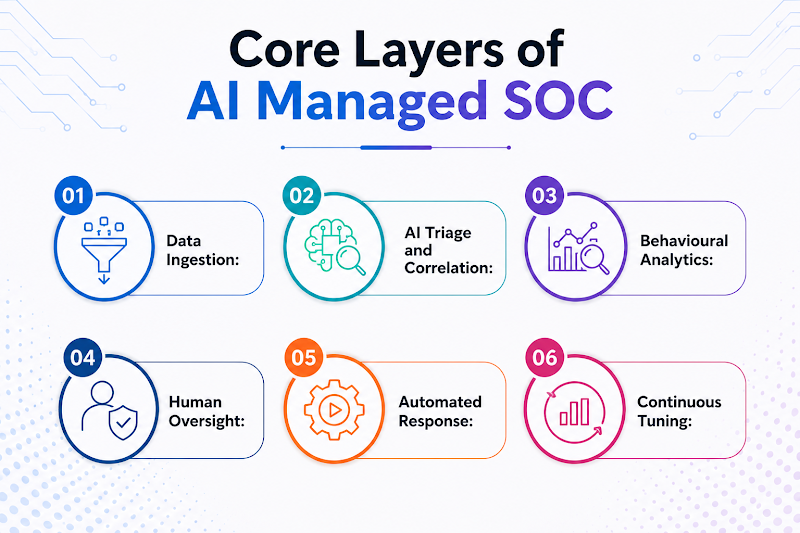
- Data Ingestion: Telemetry from endpoints, networks, identity systems and cloud workloads flows into a central layer, giving the SOC visibility across the full environment rather than isolated pockets of it.
- AI Triage and Correlation: Alerts are enriched, deduplicated and linked to related events automatically, cutting through noise before a human analyst sees anything.
- Behavioural Analytics: Models trained on normal activity patterns flag deviations that static, rule-based systems would miss entirely.
- Human Oversight: Analysts review high-confidence findings, validate context and make the final call on containment actions.
- Automated Response: Pre-approved actions, such as isolating an endpoint or blocking an IP address, execute quickly once a threat clears agreed confidence thresholds.
- Continuous Tuning: Feedback from analyst decisions retrains the models over time, so accuracy improves rather than stagnates.
Layered this way, the SOC stops functioning as a single alert queue and starts behaving more like a system that learns from its own case history.
What To Look for in a Managed SOC Partner
Not every provider marketed as an AI SOC is built the same way, and the differences matter more than the sales language around them. A few questions are worth putting to any prospective partner directly.
Ask how much of the platform’s automation has actually been tuned to your environment, rather than shipped as a generic model. Ask what happens when the AI is uncertain, since a system that escalates ambiguous cases to a human is a very different design choice from one that guesses. Ask, too, how alert data is retained and who has access to it, particularly for organisations working under sector-specific compliance obligations such as those from the RBI or SEBI in the Indian financial sector.
A managed SOC that combines round-the-clock monitoring with AI-driven triage tends to suit organisations that need continuous coverage but cannot justify building and staffing a full internal team. Smaller and mid-sized businesses gain a level of coverage that would otherwise sit well beyond their internal headcount.
Conclusion
An AI Managed SOC is not a bolt-on feature for an existing security stack. It is a shift in how detection, triage and response are structured, with AI absorbing the repetitive analysis work so human analysts can focus on judgement calls that actually need them. Attackers are already using automation to move faster, and a manual-only SOC model struggles to keep that pace.
CyberNX’s AI Managed SOC as a Service combines round-the-clock monitoring with AI-driven detection and experienced analysts overseeing every escalation, built to give growing businesses enterprise-grade coverage without the overhead of building a SOC in-house. If your organisation is weighing up whether to build, outsource or upgrade its security operations, connect with their experts to see how it would fit your environment.